Congratulations to Yue Mao for his paper accepted by ACS Sustainable Chemistry & Engineering!
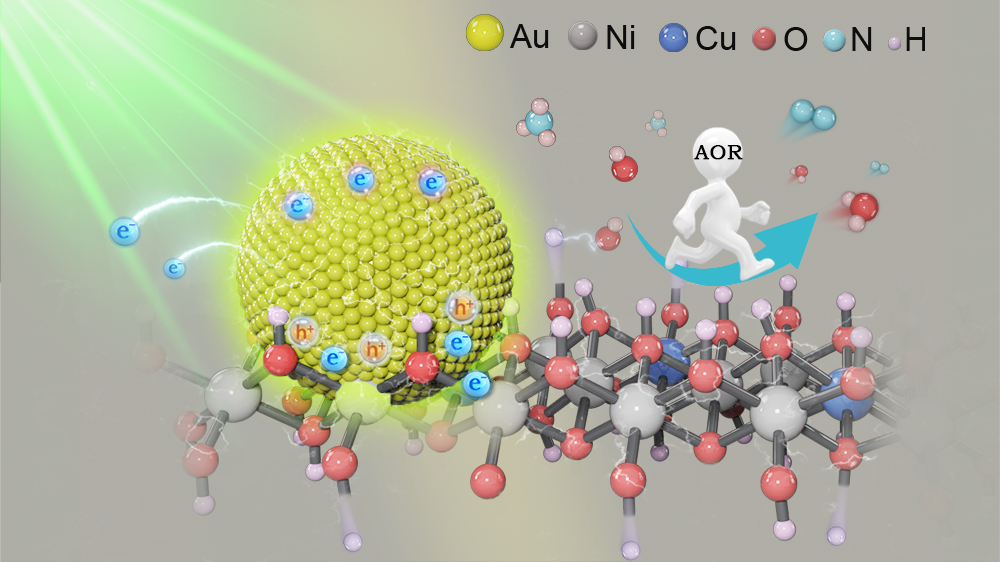
The dynamic regulation of electronic structures of catalysts at interfaces is essential for enhancing solid–liquid heterogeneous catalytic reactions. Here, we report a plasmon-mediated continuous electron transfer strategy to trigger in situ surface reconstruction of Ni1–xCux layered double hydroxide (Ni1–xCux LDH) for efficient ammonia oxidation reaction (AOR). By electrostatically assembling Au nanoparticles (Au NPs) onto Ni1–xCux LDH nanosheets, we establish a heterointerface that enables spontaneous electron transfer from LDH to Au NPs. Under 540 nm light irradiation, localized surface plasmon resonance excitation of Au NPs generates hot holes that act as dynamic electron acceptors, continuously extracting electrons from the LDH support. This process lowers the potential required for surface reconstruction into the active γ-Ni1–xCuxOOH species. As a result, the Au–Ni1–xCux LDH catalyst achieves an onset potential of only 1.38 V at 5 mA cm–2 and a Tafel slope of 45.27 mV dec–1 under illumination, significantly outperforming pristine LDH and dark conditions. The photoelectrochemical analyses further confirm that LSPR-induced hot holes promote the formation of high-valence Ni species, enhancing AOR kinetics and N2 selectivity. This work establishes plasmon-mediated surface reconstruction as a viable route for designing adaptive, energy-efficient electrocatalysts for ammonia oxidation and beyond.